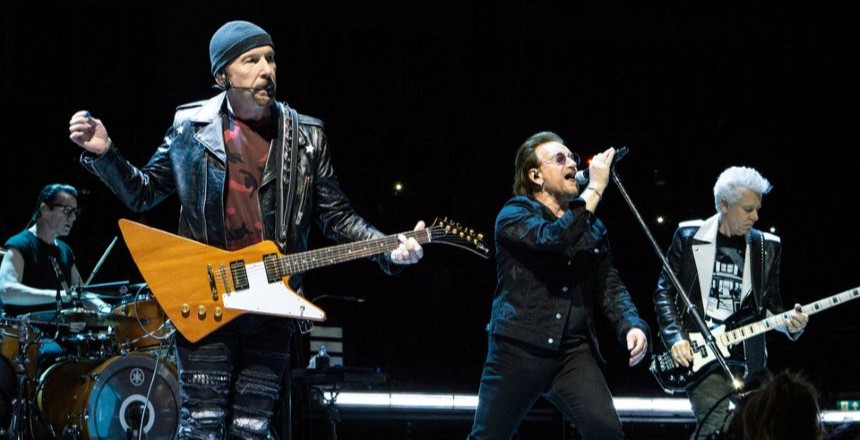
In September 1976, four teenagers in Dublin, Ireland, crowded into the Mullen family’s kitchen for their first rehearsal as a band. Bono (lead vocalist), the Edge (lead guitar and keyboardist), Adam Clayton (bass guitarist), and Larry Mullen Jr. (drummer) still play together, in the same roles they held that first day. Fifty years, same four members. In the entertainment world, that’s an impressive feat. Most bands are fortunate to survive a single decade.
On September 25, 2026, U2 marked its golden anniversary by going back to its roots and playing for students at Mount Temple Comprehensive School, where the four first met. Later that day they surprised thousands of fans with a performance from a balcony above Grafton Street in central Dublin. A new album, Carnaval De Luz, arrived on November 13, the band's first full-length album of new material since 2017.
U2 has not just survived, the band has thrived. U2 has won 22 Grammy Awards and staged some of the highest-grossing tours in history. That Grammy count as of 2026 puts them in the lead in the category of group or duo. As David Marchese observed in a recent interview with Bono and the Edge in The New York Times, few other rock acts have reached that level of acclaim. What may be unmatched is that the same four people earned all of it together.
What can the rest of us learn from U2’s story and apply to the groups we’re in? I have written about U2 several times over the years because I believe the answer to how the band has lasted is the same answer that helps any team thrive: U2 has a Connection Culture.
A tale of two bands
To appreciate what U2 has built, and sustained, consider another band of four men with comparable talent but a very different group culture: The Eagles. Its founding members in 1971 were Glen Frey, Don Henley, Bernie Leadon, and Randy Meisner.
In the 1970s The Eagles got off to a fast start, recording hit after hit: “The Best of My Love,” “One of These Nights,” “Lyin’ Eyes,” “Take It to the Limit,” and “Hotel California,” to name a few. But behind the scenes, ego and resentment were building.
In the first decade, the group added a fifth member, Don Felder; Leadon left in 1975 and was replaced by Joe Walsh; and Timothy B. Schmit replaced Meisner in 1977. The Eagles’ sixth album, The Long Run, released in 1979, took about 18 grueling months to finish, and by the end of the tour that followed, the band of five was exhausted and tense.
The breaking point came on July 31, 1980, at a benefit concert in Long Beach, California, for Senator Alan Cranston. Frey and Felder clashed backstage, and their private feud spilled onto the stage. Throughout the set, the two traded threats about the beating they planned to give each other once the show was over. Felder smashed a guitar as he left. The night became known as the "Long Night at Wrong Beach." The band stopped working together.
The culture had become so toxic and the relationships so broken that Don Henley reportedly said The Eagles would reunite only when hell freezes over. It took 14 years. When the five members finally regrouped in 1994, they named the reunion album and tour Hell Freezes Over.
The reunion was a commercial triumph, but the culture had not been healed. Before the split, financial profit had been shared equally among the members. Post-split, Frey and Henley exerted more control over the others and received a higher percentage of the profits. Felder had agreed to rejoin for less money, with the understanding that there would be a renegotiation of the splits after a defined period. That didn’t occur. Felder was later fired by Frey and Henley in 2001, and he sued his former bandmates. The case was settled out of court in 2007.
Think of what was lost. Fourteen of the most productive years of these musicians' lives passed without the band creating and performing together. Talent was not the issue. Culture was. When people feel controlled, unappreciated, undervalued, or unheard, even the most gifted teams come apart.
Vision: embracing a shared purpose bigger than fame
A Connection Culture is created when leaders communicate an inspiring vision, value people, and give them a voice. Let’s look at how these three elements of a Connection Culture serve to unite a group.
The element of Vision is comprised of mission, values, and reputation. It creates a shared identity, and U2's has been remarkably durable.
You might expect a band's mission to be hit records and sold-out stadiums. U2's mission has always been to improve the world through its music and influence. Bono calls it "the spark," and he believes it sets U2 apart. Their songs take on human rights, social justice, and matters of faith. Bono has described himself as a traveling salesman of ideas wrapped in songs.
For example, the Edge has described the mood of our times as anxious and despondent, with many people feeling lost and isolated. So U2 set out to make Carnaval De Luz a counterweight: a celebration that brings people together around shared hopes. Bono calls it defiant joy. It is not denial of the darkness, according to the Edge, but looking it in the face and still choosing joy.
U2's vision includes a standard of excellence. Bono has described it as a desire to reach the band's own potential, which he distinguishes from envy of what others have. As teenagers, the four made a pledge never to walk onto a stage without giving everything. Fifty years later, they say they have kept that pledge.
Leaders can give their teams the same: a mission, values, and reputation that inspire and unite them through contributing to the greater good.
Value: caring for one another as people
Valuing people creates shared empathy, and U2's story is full of it.
Few things tell people they are valued more clearly than being respected and recognized, a lesson The Eagles learned the hard way. Bono, the band's megastar lead vocalist, consistently praises his bandmates and credits them as essential to his success. He has called U2 the best example he knows of how to rely on others. U2 was reported to have split its earnings equally among the four band members and their longtime manager who was with them for 35 years. Contrast that with The Eagles' reunion, in which a smaller share of the earnings for one member was itself a lasting source of grievance.
The band has rallied around its members in hard times, putting the person ahead of the band's performance. Bono's mother had died when he was 14, and he grieved largely alone. A few years later, Larry Mullen Jr.'s mother was killed in a car accident. Having known that loneliness himself, Bono reached out to console Larry, and the two formed a close friendship. When an early record deal offer required replacing Larry with a more conventional drummer, Bono told the executives, in effect, to shove it. The bandmates supported the Edge through a painful divorce and Adam Clayton through his recovery from addiction.
Leaders can follow U2's example by praising colleagues' contributions and sharing credit and rewards fairly. Leaders who show up for colleagues in hard times convey to them they matter as people, not just as performers.
Voice: arguing well and deciding together
Giving people a voice creates shared understanding. U2 does this through a participative, consensus-oriented way of making decisions.
If any member strongly opposes a proposal, the band will not move forward with it. That does not mean U2 avoids conflict. The members argue relentlessly about their music, which reflects their passion for excellence. What matters is that the arguing serves the work rather than wounding the relationships. As the Edge told The New York Times, the band has learned that an argument usually signals that something is not quite right yet. When everyone instantly agrees, they know they have found it. Bono has acknowledged that the process can be frustrating, but the band considers it necessary.
U2 also listens to outsiders. U2’s newer managers have challenged the band to show up in unexpected places to reach new listeners. Bono was surprised that all four of them were open to the ideas, including Larry, who said he was suspicious but listening. After 50 years, that humility to keep learning may be the most impressive thing of all.
Leaders who make important decisions collaboratively and welcome healthy disagreement about the work get better decisions and stronger commitment. Leaders are wise to stay open to fresh ideas from inside and outside the team.
Being intentional about connection
The Eagles and U2 both had talent. The difference was culture. One band let ego, resentment, and control break it apart for 14 years. Today, only two members from the 1970s, Don Henley and Joe Walsh, remain in the group. The other band has remained connected for 50 years by intentionally living out Vision, Value, and Voice.
Vision + Value + Voice = Connection. Imagine what your team could accomplish if it were still creating together, and still getting better, in years to come.
This is an extended version of an article titled, "Golden Age: U2's Connection Culture Builds on Vision, Value and Voice," published by Smartbrief.
About the Author
Michael Lee Stallard, MBA, JD, is a thought leader, speaker and leading expert on how human connection in workplace cultures affects the health and performance of individuals and organizations. In addition to Fired Up or Burned Out, he is the primary author of Connection Culture: The Competitive Advantage of Shared Identity, Empathy, and Understanding at Work.
Image of U2 courtesy of Paul Jones under CC BY-SA 4.0 license. Image has been cropped.